


The biggest reason wealthy clients skip investment-linked insurance: nobody brought it up

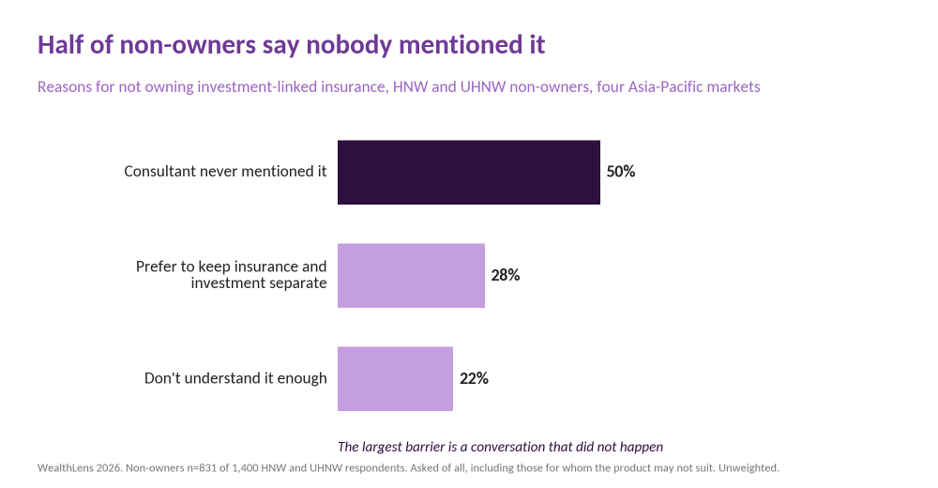
Half of high net worth and ultra high net worth investors who do not own investment-linked insurance say their consultant never mentioned it, the largest reason by a wide margin. Most would welcome more contact from their agent, and four in ten review their cover only when someone prompts them.
The leading reason wealthy clients give for not owning investment-linked insurance is that nobody raised it.
In WealthLens 2026, 30% of high net worth and ultra high net worth respondents in Australia, Singapore, mainland China and Hong Kong say they do not own an investment-linked assurance scheme because their insurance consultant never mentioned one. A third (34%) do own one, and 7% are not sure.
Among the 831 respondents who do not own one, that reason accounts for half (50%).
Preferring to keep insurance and investment separate (28% of non-owners) and not understanding the product well enough (22%) trail well behind.
The question went to everyone, including people the product may not suit, so not every unmentioned conversation was a missed sale. The leading barrier still sits with distribution, in a conversation the consultant did not start.
Clients wait for the insurer to call
The same clients leave the timing to the provider.
Four in ten review their cover only when prompted: 20% when their agent makes contact and 21% when the insurer sends a reminder. Fewer, 30%, review on a fixed schedule, and 17% when something unexpected happens, such as a job loss or a health scare.
They also say they want the prompt. In all, 61% would like agents to initiate contact more regularly to discuss their current needs, rising to 63% among those whose consultant never mentioned investment-linked insurance.
The group least interested in more contact is the one that has already decided: among respondents who prefer to keep insurance and investment separate, 52% want more contact.
Information alone does not fill the gap. A Singapore respondent in a separate Agility interview study on insurance and legacy planning described the problem with finding things out alone: “Information, I think there’s too much information, there’s a bit of information overload.”
Another described what a well-placed prompt looks like: “This agent was telling me that, you know, instead of taking away the higher portion, the private hospitalization, I may as well consider buying a critical illness care.” Two accounts do not measure how often either happens, but they show the agent’s suggestion doing work that self-directed research does not.
Trust is high and largely unused
Trust in agents is high. Three in four respondents (76%) say they trust their agents, and around seven in ten agree that agents recommend products that meet their needs (71%) and can explain the pros and cons of what they sell (70%).
The agent already has the client’s confidence. In half of the non-ownership cases, the agent has not used it to raise this product.
Understanding is a bigger obstacle at the top. Among ultra high net worth respondents, 18% say they do not own the product because they do not understand it well enough, against 11% of high net worth respondents.
The wealthier client, often with a more complex portfolio, is more likely to need the explanation that only a conversation provides.
Clients say as much about what they want from a provider.
Asked what matters most when choosing an insurer, 45% name a consultant who keeps in regular contact to check whether their needs have changed, close to the most-chosen answer, informative and easy digital touchpoints (48%), and level with being able to talk to a representative easily (46%). Contact counts as a reason to choose a provider.
And many clients are choosing. In the same survey, 64% say they are looking for a new insurance provider, 21% within the next six months. Among respondents whose consultant never mentioned investment-linked insurance, the share looking reaches 66%. A conversation the current agent does not start is one a competitor can.
Where the missing conversation is most common
Australia shows both ends of the problem. Australian respondents report the highest ownership, at 47%, against 30% in Hong Kong and 29% in mainland China.
Yet 59% of Australian non-owners say their consultant never mentioned the product, the highest share of non-owners in the four markets.
Hong Kong leans most on the agent to start things.
Among all respondents there, 34% say their consultant never mentioned the product, the highest share of all respondents in any of the four markets, and 25% review their cover only when their agent makes contact, against 20% overall. In mainland China, by contrast, the barrier is more often a deliberate preference: 32% of non-owners there would rather keep insurance and investment separate, and 44% say the subject never came up.
The pattern points to a measure most distribution teams could add without new research: for each eligible client, whether investment-linked insurance has been explained at all.
A client who heard the case and declined has made a decision. A client who was never told sits in a gap in the contact schedule.
For an insurer, each eligible client in that gap is a sale nobody attempted, and in this sample those clients make up half of everyone who does not own the product.
Source note
WealthLens 2026, n=1,400 high net worth (900) and ultra high net worth (500) respondents in Singapore (300), mainland China (500), Hong Kong (300) and Australia (300). No weighting applied. INSUILAS (single choice); non-owners = three “No” answers (n=831); asked of all, including those for whom the product may not suit. REVIEINS, INSURPER r2, r4, r7, r8, RELATINS, LOOKPROV r3. Verbatims: separate Agility qualitative study in Singapore, English originals, anonymised. Body: 826 words.

