


Wealthy clients would follow their relationship manager out the door, and most are already shopping.

Two in three high net worth and ultra-high-net worth investors in four Asia-Pacific markets would move their private banking relationship if their relationship manager left. Six in ten are looking for a new provider anyway. Loyalty belongs to a person, and it does not stop the search.
Wealthy clients are loyal to a person more than to a bank.
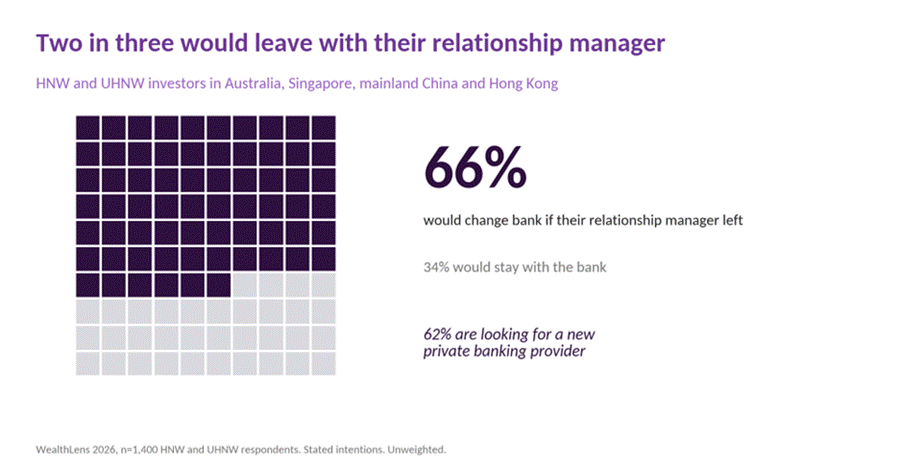
In WealthLens 2026, 66% of high net worth and ultra high net worth respondents in Australia, Singapore, mainland China and Hong Kong say they would change their private banking relationship if their assigned relationship manager left.
A third (34%) would stay with the institution.
The figure barely moves with wealth: 67% of ultra high net worth respondents and 66% of high net worth respondents would follow.
That loyalty sits alongside an active search.
In the same survey, 62% say they are looking for a new private banking provider: 18% within six months, 26% within a year and 18% with no set date.
Among ultra high net worth respondents the figure reaches 76%, and 24% of them expect to look within six months. The search runs across all four markets, from 59% of respondents in Singapore to 64% in Hong Kong. These are stated intentions, not completed moves.
Loyalty to the relationship manager does not slow the search.
Among respondents who would follow their relationship manager, 67% are looking for a new provider, against 54% of those who would stay with the bank.
The clients most attached to an individual are the ones most open to moving.
Contact is frequent and comparison continues
These clients hear from their bank often.
Three in four (77%) deal with their primary private bank at least once a month, and 26% several times a month.
Frequent contact and an active search coexist, which suggests the search reflects a habit of comparison rather than an absence of attention.
Most of these clients already hold more than one relationship.
Three in four (74%) use two or more private banks, and among those who named a main wealth manager, 46% said it was an independent financial adviser, against 24% who named a traditional wealth or asset manager and 15% a private bank.
In Singapore, private banks come out ahead of the average, named by 24% as the main manager.
A Singapore respondent in a separate Agility interview study described the arrangement: “I’m currently, have a RM, Relationship Manager, to help me. I’m also investing on my own.”
A client who already spreads money across several banks can move part of it without moving all of it.
The reasons for looking are spread almost evenly.
Among those looking, each listed reason, from a better digital offering and values alignment (33% each) to poor performance (28%), sits between 28% and 33%.
A relationship manager leaving is cited by 30%. With no dominant complaint, the search reads as comparison more than protest.
What clients say they choose on
The criteria for choosing a bank point to the relationship manager’s role.
Asked for the three most important factors when choosing a bank or wealth manager, the most chosen is a bank that proactively reviews their financial status and suggests improvements (27%), followed by a track record of investment performance (26%).
Global presence, transparency on fees and honest product comparisons follow at 23% each. Proactive review is something clients experience through a person.
What they value in the ongoing relationship is spread across service and access.
Informative, easy digital touch points (46%), being able to talk to a representative easily (46%) and competitive rates and fees (44%) lead, with lifestyle privileges at 42%.
Channel preferences confirm that a person stays central: half (50%) want to meet their consultant once to build the relationship before moving to digital channels, 18% want to meet every time, and 23% would rather not meet at all. In Singapore, 65% prefer the meet-once model, while Hong Kong is the most digital market, with 31% preferring not to meet.
Trust in the adviser is high: 74% say they trust their wealth adviser, and around seven in ten agree that advisers are knowledgeable about their products (71%) and provide tailored planning (68%).
Fewer, 57%, want their adviser to initiate contact more regularly, a lower share than the 61% who want the same from insurance agents.
A single relationship manager is a single point of failure
The relationship manager carries the client’s trust and delivers the proactive review clients rank first, while the client keeps comparing providers regardless.
A client who knows only one person at the bank has little reason to stay once that person goes, and two-thirds of respondents say as much.
The practical measure follows directly: for each client relationship, how many people at the bank the client knows, and whether the bank’s own proposition, from reviews to research and access, reaches the client through more than one of them.
A bank that builds every client relationship around one named manager carries a risk its clients have already described: when the manager leaves, two-thirds of them say the relationship goes too.
Source note
WealthLens 2026, n=1,400 high net worth (900) and ultra high net worth (500) respondents in Singapore (300), mainland China (500), Hong Kong (300) and Australia (300). No weighting applied. RELMANAGER, LOOKPROV r1 and c1 (reasons asked of 870), PRIVBANK, WMGR (asked of 1,168), FREQUENCY, CRITBANK (top three), RELABANK, DIGCHPRE, WMGMTPER. Stated intentions, not observed switching. Verbatim: separate Agility qualitative study in Singapore, English original, anonymised. Body: 797 words.