


The 8% Trap: Why Most Wealth Firms Are Building for the Wrong Client
[4-5 Min Read]

Trusted to advise, not to decide: the mandate most advised clients never hand over.
A relationship manager’s Tuesday has no meeting in it. The client reviews are monthly, and the weeks between them are the hours nobody plans for. At ten past nine a client calls. He has been reading about moving part of his allocation, he has talked it over at home already, and he wants to know whether it is a reasonable thing to do. There is no note in front of the manager, because nothing has happened since the last review that produced one. Nothing is bought on the call. Nothing is logged. By the evening the client has decided.
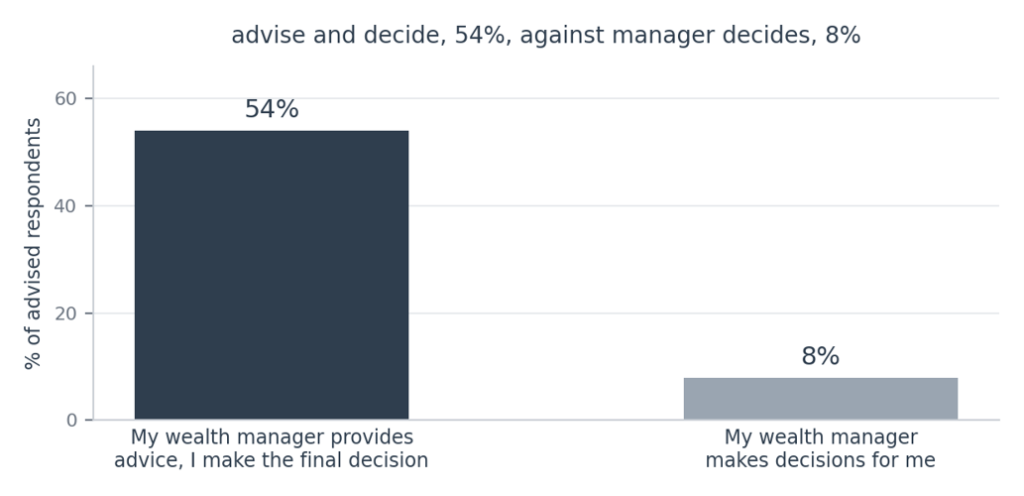
Across Australia, China, Hong Kong, and Singapore, 54% of respondents who use an adviser, a base of n=1,106, say their wealth manager advises and they make the final decision. The manager decides for 8%. A further 28% decide to use the manager to execute, and 10% run a hybrid of the two.
That puts the growth question on advisory capacity. A firm reading discretionary mandates as its main measure of progress is measuring the smallest of the four arrangements in this sample. The largest is a conversation. Three functions own a different part of it: the relationship manager who must have something to say when the call comes, the product team whose recommendation has to survive a client acting as last approver, and whoever prices an advice layer the client is already consuming.
76% trust their adviser, so the constraint is capacity.
Confidence in this sample does not read as a wish to be left alone. In the four markets, 76% agree they trust their wealth adviser, and 57% agree they would like an adviser to more regularly initiate contact about their current needs. We would read that as a capacity question rather than a permission question. The invitation is already there, and the client keeps the decision because that is the part worth keeping.
Delegation still has a constituency, and it extends past the 8%. The 10% on a hybrid arrangement are buying discretionary management for part of the book, and 17% of the four-market sample say they need no adviser support at all, which puts them outside the advised base by design. A proposition built only for advice leaves both groups unserved.
53% see their bank monthly, and the decision does not wait for the meeting.
Contact is regular and it is not continuous. Among those who answered the frequency question, a base of n=1,321, 53% interact with their primary private bank once a month. Set that against the 45% of the four-market sample planning to change their asset allocation in the next six months, and the calendar does most of the work: a decision that arrives in week two waits, or it gets made without the bank in the room.
So, the question becomes what exists in that gap. For the relationship manager, the binding constraint is cadence and recommendation quality, not mandate conversion. A scorecard counting mandates won records nothing on the Tuesday call, where the transaction the majority describes happens. Counting advised decisions per client, alongside mandates, makes the 54% visible as revenue in the scorecard.
Platform owners can treat the between-meeting window as a surface to be served, with the recommendation on record and a route to execution the client can use without leaving the firm. The study does not measure which channel a client uses to place a trade, so channel design belongs in testing.
Independent advisers hold the main relationship for 48% of advised clients.
The competition for that conversation is already priced. Independent financial advisers are named as the main wealth manager by 48% of advised respondents, against 14% for a private bank. We read the 48% as the competitive frame: the contest for the advised decision is run against firms that sell advice as the product and charge for it as one.
If that is right, an unpriced advice layer is the exposure, because it is what gets given away in the contest that matters most. Pricing advice as its own line, separate from mandate and custody, gives the firm something to defend when the client keeps the decision. It also gives the relationship manager a reason to write the recommendation down.
Product teams meet the same client at the end of the approval chain. Recommendations that ship with the downside case, the exit, and the fee already attached give that client what the approval requires, and the gain is fewer late declines on products that were never argued past the first objection.
Australia puts 36% on execute-only, against 21% in China.
The four markets do not sit in the same place. Australian advised respondents put 36% on the model where they decide and the manager executes, against 21% in China. On these levels, an Australian build weighted toward discretionary capability is aimed at the thinnest part of that market, and the sequencing question there is execution quality first.
Two things bound the reading. The question asks which approach a respondent primarily takes, so it records the arrangement in place and not a preference between arrangements on offer. And this is one measurement, which gives a level and not a movement, so where a firm’s own book differs from these levels the book is the better guide.
Fund the advised decision first.
Heads of advisory in these four markets have a sequencing decision, and the evidence supports one order. Fund what serves the 54% first: recommendation quality, contact cadence, and an execution route for the client who wants to place the call themselves. Keep discretionary capability at the scale of the 8% it serves and use the 10% hybrid group as the case for holding both inside one relationship.
The Tuesday call is the product. A firm that can put something on record in that call and let the client act on it before the evening is selling the arrangement most advised clients already describe.
Source note: WealthLens™ 2026; Australia n=292, China n=500, Hong Kong n=300, Singapore n=245, four-market total n=1,337. Advice-model figures use respondents who use an adviser: total n=1,106, Australia n=263, China n=380.