


Most wealthy clients planning time abroad already own a home there

Over the next five years, 34% of affluent and high net worth respondents across Australia, Singapore, mainland China, and Hong Kong plan to move abroad or spend a significant period in another country. Most expect to come back, and most already own a home where they are going.
Most affluent and high net worth respondents who plan a long spell overseas already own a home at the other end.
Among the 451 respondents planning to move to or spend a significant period in another country within five years, 82% hold residential property in the place they named, either as a holiday home or as an investment.
Owning the destination home changes what the plan asks of a wealth manager. An emigration is one transfer of accounts, handled once.
A long stay away from a home the client keeps is a different job: the client has two addresses, and the relationship must work at both for as long as the stay lasts.
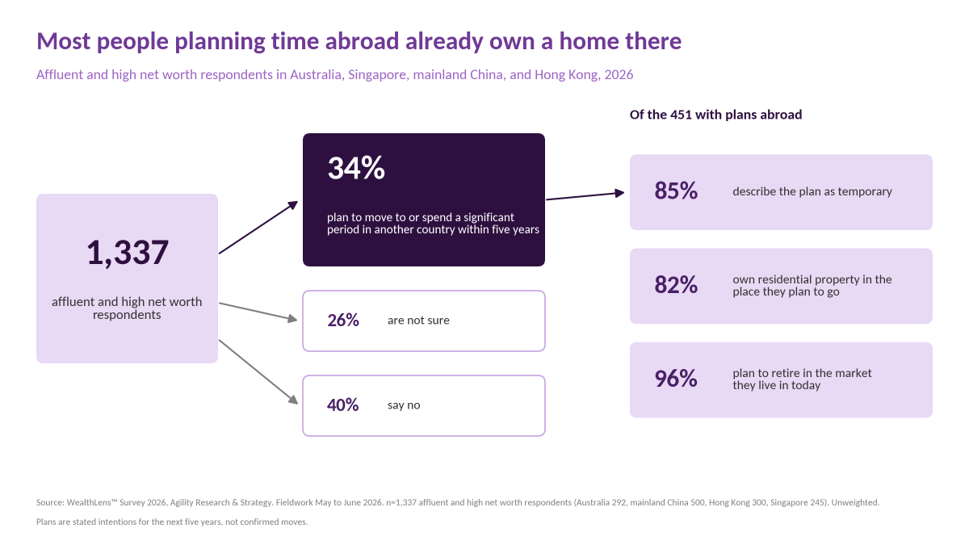
Most respondents planning time abroad expect to come home
Of the 451 respondents with plans abroad, 85% call the plan temporary, and only the remaining 15% intend to go permanently.
Respondents planning time abroad also expect to retire where they live today. Asked where they plan to retire, 96% of them named their current market.
We would read respondents with plans abroad as people adding a second address and keeping the first.
Their plans are stated intentions for the next five years and can still change, and a further 26% of all respondents said they were not sure whether they would spend a long period abroad.
Ultra high net worth respondents are the most likely to plan time abroad
Among ultra-high net worth respondents, 46% plan a move or a significant period abroad, against 27% of high-net-worth respondents.
That 19-percentage point gap makes ultra-high net worth respondents about 1.7 times as likely to have plans abroad, which makes the wealthiest relationships the place to start.
Tax sits in the middle of the reasons respondents give for planning time abroad.
Of the 451 with plans, 24% cite the tax or regulatory environment, below a different culture or lifestyle and a better quality of life, and no single reason is chosen by more than a third. A spread of reasons that wide makes a plan abroad a conversation for the relationship manager as much as for a tax adviser.
The service model has to work at the second address
The model to test is one set up for a client at a single address.
Consider a mainland China client who owns a home in London and plans a long stay there: the relationship manager at home and the account booked in Hong Kong both must keep working while the client is in London.
Residency and tax treatment during a long stay depend on the client and the countries involved, so they are matters to check case by case rather than assume.
A firm is ready for these clients when, for each ultra-high net worth relationship, it can say where the client expects to spend the next five years, has the property abroad on file next to the accounts at home, and knows which of its services still work at that address.
Without the property abroad on file, the head of client proposition is planning for a client who expects to spend long stretches of the next five years at an address the firm has never recorded.
Source note
Source: WealthLens™ Survey 2026, Agility Research & Strategy. Fieldwork 29 May to 29 June 2026 among affluent and high net worth respondents in Australia (n=292), mainland China (n=500), Hong Kong (n=300), and Singapore (n=245); total n=1,337, of whom high net worth n=841 and ultra high net worth n=496. Figures for people planning time abroad rest on the 451 respondents who said they plan to move to or spend a significant period of time in another country in the next five years. No weighting was applied.