


A second account is a second relationship: offshore holding among Singaporean respondents reaches 64% | 27 August 2026
Sunday evening in an apartment off Upper Bukit Timah Road, and the phone comes out after dinner. Two banking apps. One local, one for an account opened in the United States two years ago.
Wei Ming checks both balances, reads the twelve-month performance line on each, and puts the phone down without calling anyone. He has used the same two private banks since he started investing. Someone else is in the next room. He expects the coming year to be better than the one behind him, and he writes none of that down.
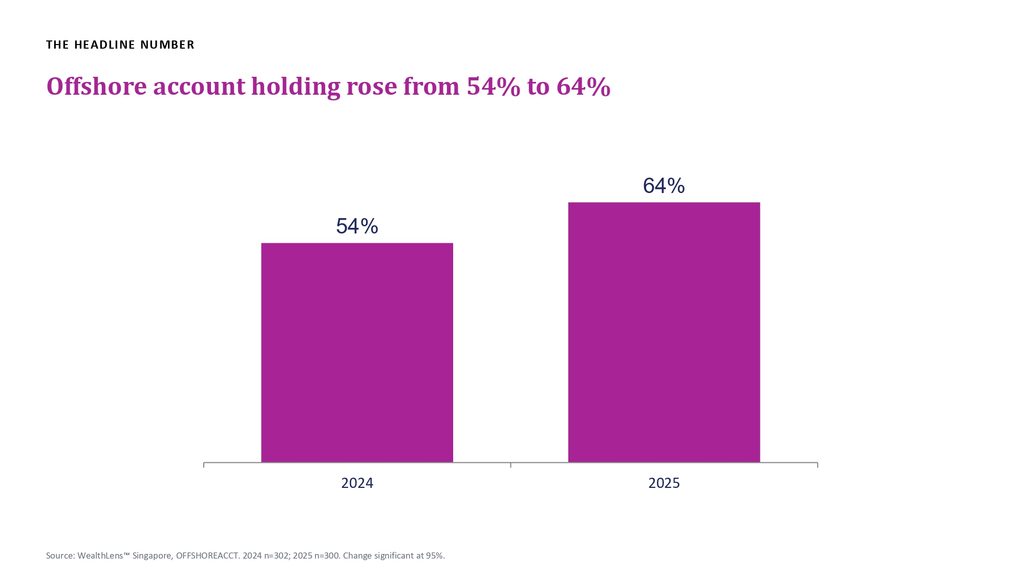
64% of Singaporean respondents held an offshore account in 2025, against 54% a year earlier. Three booking centers gained at once, and none of them gained at another’s expense.
That is close to two-thirds of the Singapore sample holding money outside the country, spread across three centers that grew together. Every one of those accounts sits somewhere. The data records where the money went.
Who is holding it is not in these tables, and that absence is the exposure. A client whose money moves to a center a Singapore desk cannot book has been handed a reason to open a relationship elsewhere. The desk does not necessarily hear about it. That is a coverage question before it is anything else.
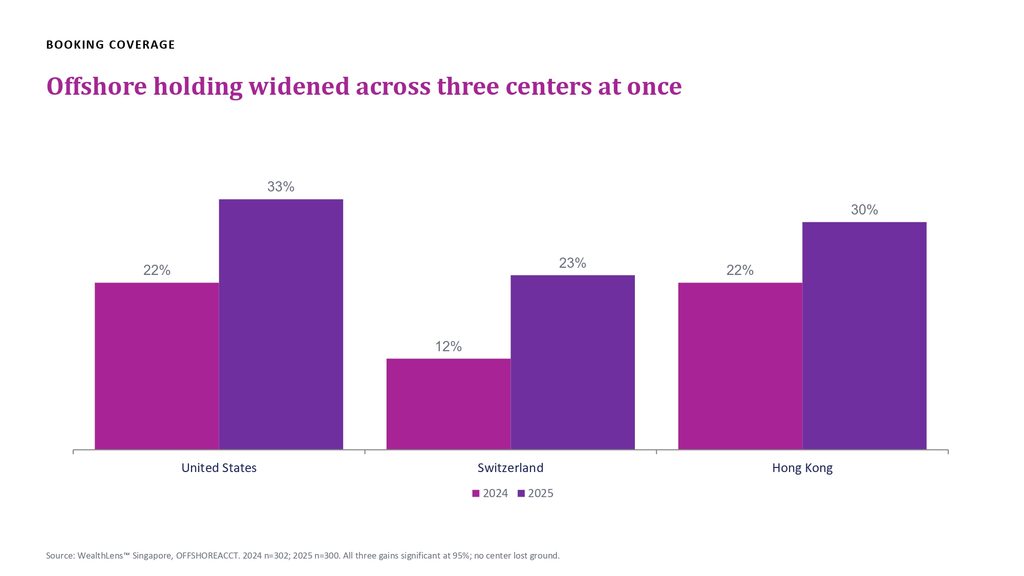
The two centers that gained most sit furthest from Singapore
Offshore accounts in the United States went from 22% to 33%, and in Switzerland from 12% to 23%, a gain of 11 points each. Hong Kong went from 22% to 30%. Switzerland nearly doubled. No center lost ground to another, so what happened across these two waves is a widening rather than a rotation, and a desk that reads it as clients switching venues will size its response wrong.
Two of the three sit outside the region, and that matters less for what it says about client taste than for what it asks of a booking platform.
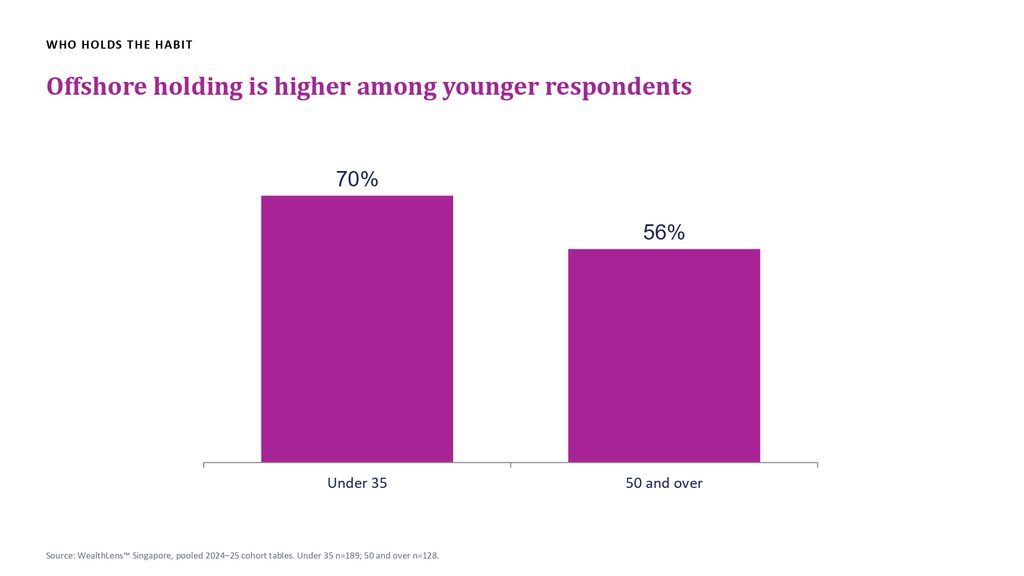
Under-35s hold offshore accounts more often than over-50s
Pooled across both waves, 70% of respondents under 35 (n=189) hold an offshore account, against 56% of those aged 50 and over (n=128). The habit sits with the younger half.
We would read that as a coverage requirement that lengthens with the relationship. It is not a forecast, and these two waves cannot supply one. What it does say is that the clients most likely to hold money in a center the desk cannot service are the clients the desk has the longest left to serve.
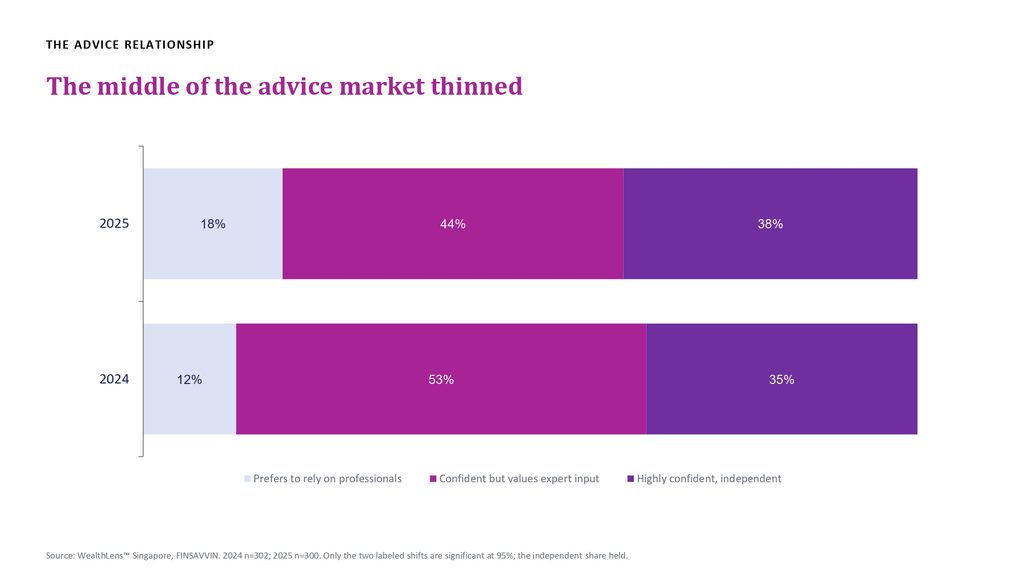
The middle of the advice market lost 9 points, and the proposition was built for the middle
The advice relationship changed shape at the same time. Respondents describing themselves as confident but still valuing expert input fell from 53% to 44%. Those preferring to rely on professionals for financial decisions rose from 12% to 18%.
The rest of the sample is confident enough to decide without help, and it went from 35% to 38%, a move these bases cannot separate from noise. The middle thinned, and the end that grew is the end that wants the decision taken for it.
Both movements land on the same desk as the offshore account. Money going to a second jurisdiction is being handled by an advisory proposition built for the client who wants input and keeps the decision, and that client is a smaller share of the market than a year ago.
One proposition is serving a shrinking group and a growing one at once: the client who wants to be shown the analysis and decide, and the client who wants it handled.
A Singapore desk has a booking question and a segmentation question
The booking question is answerable this quarter and almost entirely internal. With 33% of respondents holding a United States account and 23% a Swiss one, the test is whether a Singapore adviser can service both without handing the client to somebody else.
An adviser who already knows which entity in the group would hold the asset answers inside the conversation. An adviser who does not becomes the reason a client calls elsewhere, at the moment money is leaving the country. Building the capability in-house is the fullest answer, selective readiness the middle one, and referral the thinnest. The distance between the first and the last is the room a second relationship opens into.
The segmentation question is harder and worth more. The proposition is built around the group getting smaller, and the group getting larger is the one that wants the decision handled. That argues for building the decision-handled tier as a tier of its own, priced apart, not as a service level inside the existing one. What neither group discloses here is what it will pay. That number comes from inside the bank, out of what each tier costs to staff.
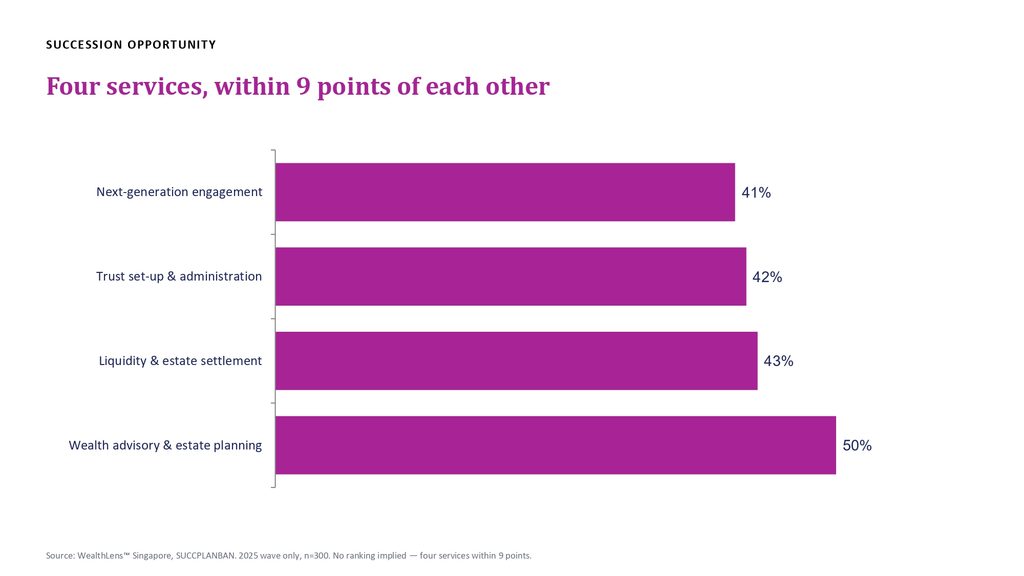
Then there is succession, where the appetite is broad and pointed at nothing in particular. 50% of Singaporean respondents would consider a bank for wealth advisory and estate planning, 43% for liquidity and estate settlement, 42% for trust set-up and administration, and 41% for next-generation engagement. Four services inside 9 points of each other describe clients open to help without a settled view of which instrument they need.
Nothing here ranks those four, and the flatness is the point: the demand described is for a conversation before an instrument. That puts a diagnostic ahead of any product pitch.
These are two waves and the samples differ in age composition, so movements are reported only where they hold against that difference.
Confirm United States and Swiss booking coverage this quarter
Singapore desks should verify they can service United States and Swiss booking centers for existing clients, and decide whether the decision-handled tier stands on its own. Neither needs new data. Both are decisions about a book the bank already has.
Wei Ming opens both apps again next Sunday evening. One of them answers to a Singapore desk, and the other one answers to somebody.
Source note: WealthLens™ Singapore, 2024 and 2025 waves. 2024 n=302; 2025 n=300; pooled total n=602. Pooled cohort bases: respondents under 35 n=189; respondents aged 50 and over n=128.