

Baby Boomers, not Gen Z, replacing new watch and jewelry purchases with pre-owned: study
Watch and jewelry brands have built defensive programs around younger customers, assuming they are the likeliest to substitute pre-owned for new.
A study released by Affluential, the affluent and high-net-worth insights division of Agility Research & Strategy, finds the opposite.
Twenty-eight percent of affluent Boomers say a pre-owned piece replaced something they would otherwise have bought new, against just 16 percent of Gen Z — reversing the assumption behind most retention spending in the category.
“Generation is the easiest variable to plan against and, in this category, it is the least useful,” said Amrita Banta, managing director of Singapore-based Agility Research & Strategy, in a statement.
“The customers trading a new purchase for a pre-owned one are the oldest, not the youngest,” she said. “Brands protecting new sales are aiming their defensive spend at the wrong end of the age range.”
Follow the money
Drawing on TrendLens 2026/27, a study of 5,800 affluent and high-net-worth consumers across nine markets, the report also finds that the store-of-value argument brands spend to establish is already settled in the customer’s mind — and that how someone made their money predicts their behavior far better than when they were born.
Fieldwork for this wave ran online from March 25 to May 7.
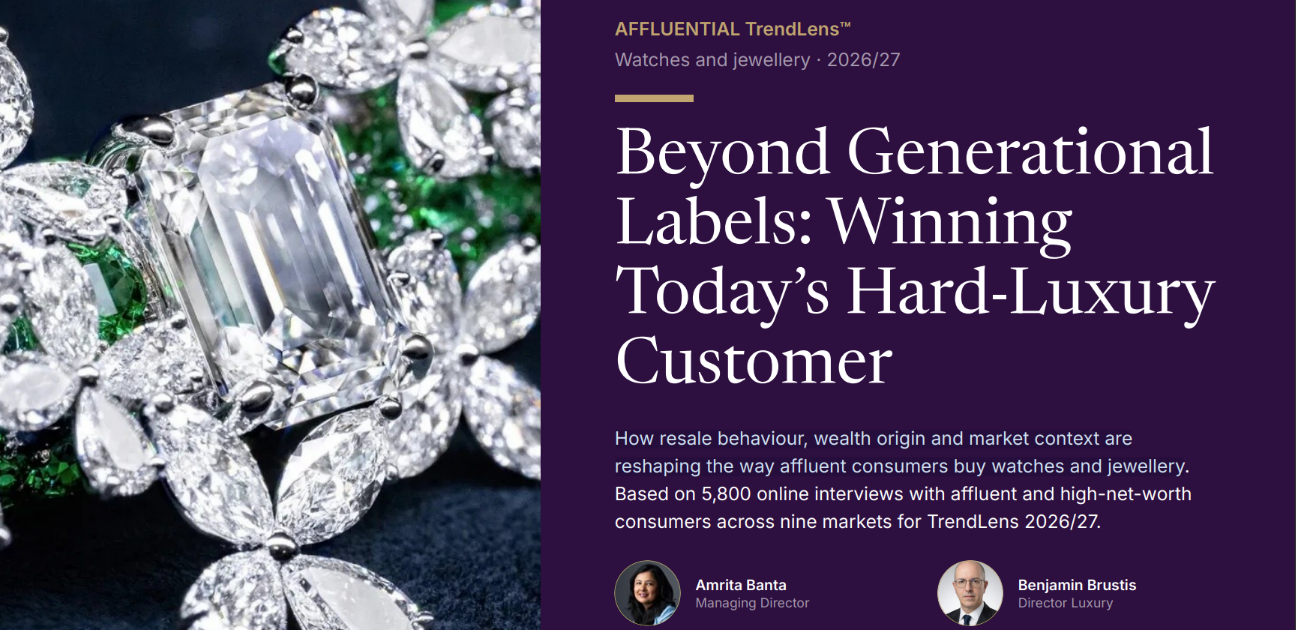
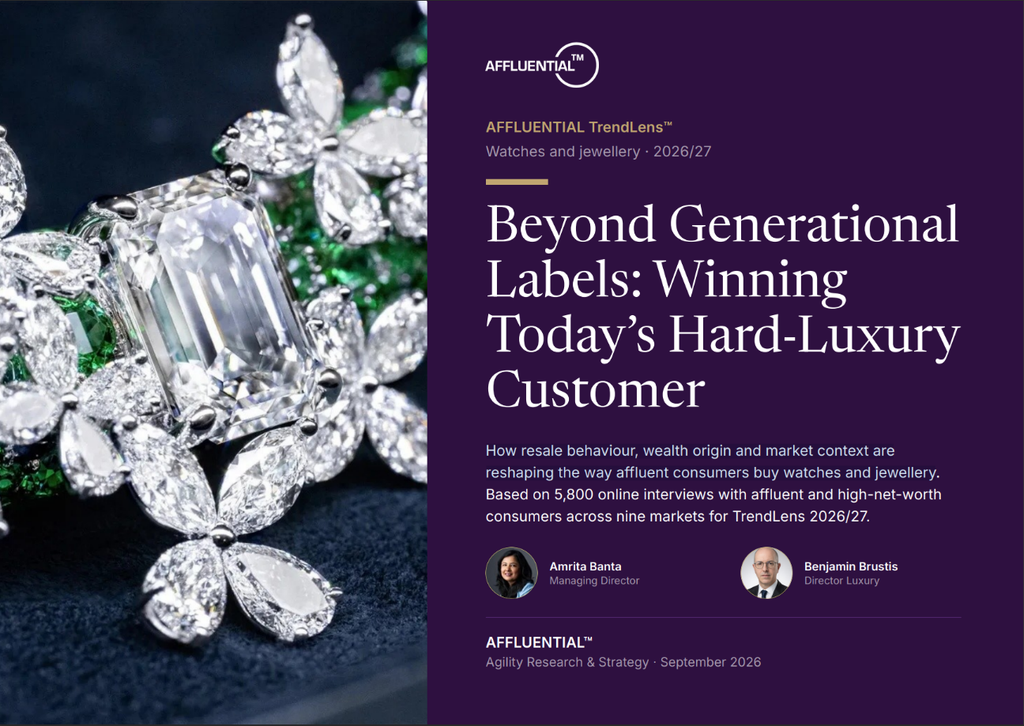
The findings were part of Affluential’s study titled “Beyond Generational Labels: Winning Today’s Hard-Luxury Customer.”
Among the key findings:
- 28 percent of Boomers say a pre-owned piece replaced a new purchase, against 16 percent of Gen Z, with Millennials (20 percent) and Gen X (24 percent) in between
- 62 percent already own watches or jewelry as an investment, making the store-of-value belief a baseline for the category, not a way to identify a customer
- 47 percent of Gen Z respondents live in China or India, so a global age result is partly a market result
Wealth origin travels better than age
The study identifies four wealth-origin groups — self-made (55 percent), inherited and added to (22 percent), primarily inherited (13 percent) and built with a partner (10 percent), present in all nine markets.
How a customer made their money separates them on how publicly they display luxury, how much they expect from an adviser, how often they buy pre-owned instead of new, and even which stone they choose.
Age, by contrast, is distorted by geography.
Value conversation already happening at counter
When customers explain why they chose one jewelry brand over another, the two most common answers are the quality or rarity of the stone or metal and how well the piece is made. Few brands equip their sales teams to answer in the same terms.
“Customers open the value conversation themselves, in the language of the object: the stone, the metal, how it was made,” said Benjamin Brustis, director of luxury at Agility Research & Strategy, in a statement.
“Few brands have equipped their associates to finish that conversation,” he said. “That is the cheapest gap in the category to close.”
Executive summary from the report
Affluent customers already treat watches and jewelry as things worth owning.
Across nine markets, 62 percent own one or both as an investment, and jewelry sits at the top of a list of 10 luxury and alternative assets.
That makes this belief a feature of the category, held widely enough that it no longer tells a brand anything about who to approach. The useful question now is which customers behave differently once they already own them.
The clearest answer sits in the resale market, and it points the opposite way to most industry planning.
Among customers who engage with resale, the share saying a pre-owned piece replaced something they would otherwise have bought new climbs steadily with age: 16 percent of Gen Z, 20 percent of Millennials, 24 percent of Gen X and 28 percent of Boomers.
Younger customers are more likely to describe pre-owned as an additional purchase.
Customer retention activations therefore belong higher up the age range, while younger audiences are better treated as an acquisition opportunity.
Age is a useful way to weight those activations, and at the same time a poor way to build a global customer segmentation.
Nearly half of the Gen Z respondents in this study live in China or India, so some of what looks like an age difference is really a difference between markets.
Wealth origin behaves more consistently.
How someone made their money separates customers on how publicly they display luxury, how much they expect from an adviser, how often they buy pre-owned instead of new, and even which stone they choose.
The three priority mature markets also need different planning: Japan leads near-term spending intention, the United States is watch-led and the United Kingdom is relatively resale-active.
There is a practical opening at the point of sale. Independent market tracking gives the category added urgency: jewelry made clearer gains in 2025 while new-watch sales were broadly flat.
When customers describe why they chose one jewelry brand over another, the two most common answers are the quality or rarity of the stone or metal and how well the item is made.
The value-retention conversation is already happening in the language of the object itself: the stone, the metal and the craftsmanship. Very few brands, however, equip their sales teams to answer it.
“Baby Boomers, not Gen Z, replacing new watch and jewelry purchases with pre-owned: study” courtesy of Luxury Marketer (November 2026). © 2026 Luxury Marketer. All rights reserved.
Please click here to download the Whitepaper: A whitepaper by AFFLUENTIAL™ – Watches & Jewelry | Affluential

