


Wealthy heirs choose their bank years before they inherit

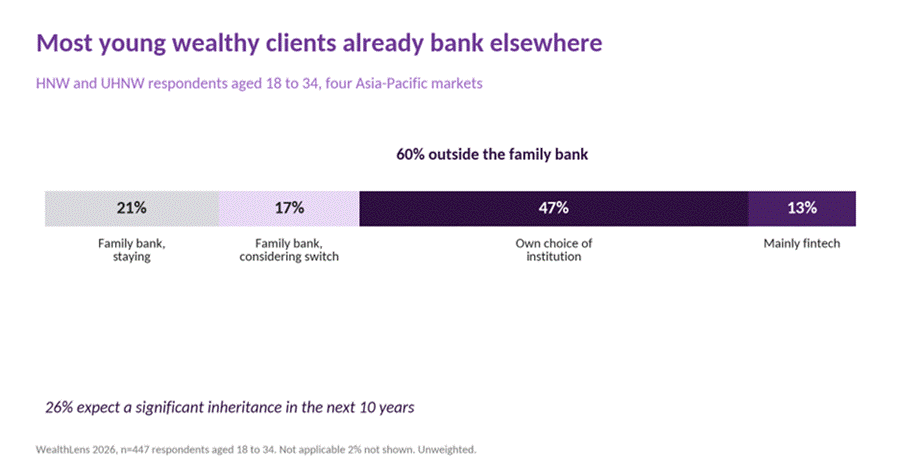
Six in ten high net worth and ultra high net worth investors aged 18 to 34 already bank outside their family’s institution, while only a quarter expect a significant inheritance within ten years. A private bank that waits for the transfer arrives after the choice is made.
Most wealthy young clients have picked a bank long before any family money reaches them.
In WealthLens 2026, 60% of high net worth and ultra high net worth respondents aged 18 to 34 in Australia, Singapore, mainland China and Hong Kong already bank or invest outside their parents’ institutions: 47% with an institution of their own choosing and 13% mainly through digital platforms or fintech services.
The family bank keeps 38% of them, and not securely: 21% use it and intend to stay, while 17% use it but are considering switching.
The money itself is further away than the planning assumes.
Only 26% of these respondents expect a significant inheritance or wealth transfer in the next ten years; 60% do not, and 14% are unsure.
Expectations vary by market, from 32% of respondents aged 18 to 34 in Singapore to 19% in Australia, but in no market does a majority expect a significant transfer this decade.
The inheritance is the wrong starting line
Taken together, the two findings reverse the usual sequence.
A bank that introduces itself to the next generation at the point of transfer arrives, for most of these clients, after they have chosen a provider and possibly a decade before any family wealth arrives.
The parent’s side of the conversation points the same way.
A Singapore respondent in a separate Agility interview study on insurance and legacy planning described what he expected to pass on: “I will probably leave them something to get started, but they would have to find their own footing.”
One parent’s view does not measure a trend, but it describes an inheritance sized to launch a child rather than to tie them to an institution.
When these younger respondents imagine an inheritance, they describe using it actively.
Asked how a future inheritance would affect their financial goals, about half say it would enhance their lifestyle (49%), help expand business ventures (48%) or fund personal development such as education and skills (48%).
A further 45% say it would increase their philanthropy, and 38% that it would bring forward retirement. The bank that holds the relationship when that money arrives will be advising on plans the client has already formed.
What the next generation does differently
Their priorities set them apart from their parents in several ways at once, and no single difference dominates.
Asked how their financial goals differ from those of older family members, 46% want more flexible, tech-enabled banking, 44% more interest in alternative assets such as crypto and collectibles, 42% a greater focus on wealth growth, and 41% each more global mobility and more self-directed decisions.
The services they value are just as evenly spread.
Each of eight next-generation services, from bespoke values-based advice to succession support, networking and financial education, is chosen by between 12% and 13% of respondents. A bank cannot win this group with one flagship offer.
The family bank still holds a real base. The 21% who plan to stay and the 17% who could still be kept are clients worth defending. Together, though, they are fewer than the 47% who have already chosen elsewhere.
The 76 respondents considering a switch are too few to rank reasons with confidence; access to exclusive opportunities is the one they mention most often.
Younger clients are also more comfortable without a branch.
Among respondents aged 18 to 34, 27% say they do not need to meet a financial consultant face to face and would rather deal through digital channels, against 21% of those aged 35 and over. Most (52%) still want to meet once to build the relationship before moving online.
A first meeting is still part of how this group chooses, which gives a bank a clear moment to be present for.
They trust the advice they have.
Among respondents aged 18 to 34, 81% say they trust their wealth adviser, and 57% are looking for a new private banking provider, against 65% of older respondents. The younger group has chosen, trusts the choice and is searching less.
Hong Kong shows the pattern most strongly
Market groups at this age are small, so the differences are indicative.
Among respondents aged 18 to 34 in Hong Kong (101 people), 72% bank outside the family institution, including 20% who rely mainly on digital platforms. In mainland China (142 people) the share is 56%, and 27% use the family institution and plan to stay, the highest of the four markets. Australia (58%) and Singapore (56%) sit between them.
The relationship, once formed, attaches to a person.
In the same survey, 66% of respondents aged 18 to 34 say they would move their private banking relationship if their relationship manager left, the same share as among older clients.
A private bank that dates its next-generation plan from the inheritance has already missed the first choice for six in ten of these clients, and for most of them the transfer it is waiting for is not expected this decade.
Source note
WealthLens 2026. Next-generation questions asked of the 447 respondents aged 18 to 34 (Singapore 100, mainland China 142, Hong Kong 101, Australia 104), 22% UHNW. The filter is age, not inheritance eligibility. No weighting applied. NEWGENBANK, ANTWEATRAN, IMPACTGOAL, NEWGENWEALTH, NEWGENSER, NEWGENSWITCH (n=76), DIGCHPRE, WMGMTPER r8, LOOKPROV r1, RELMANAGER. Market bases of about 100 are indicative. Verbatim: separate Agility qualitative study in Singapore, English original, anonymised. Body: 828 words.